Why You Need Statistical Process Analysis in Your Small Business
Most small business owners run their companies on instinct. They know roughly what is happening, they have a general sense of whether things are going well or poorly, and they make decisions based on experience and gut feel. That approach can work in survival mode. But it will never get you to an optimized, controlled, and highly profitable business.
The BDM diagnostic phase begins by searching for "financial veins of gold." These veins of gold represent the glue that binds the various elements of the business together and allows management to control the profitability of the business. Among the most important of those veins are the standard operating procedures — and the statistical process analysis that measures performance against them.
Documenting Operations
The first step is documentation. Standard operating procedures document the way every component of the business should operate. This is not bureaucracy for its own sake. It is the foundation of control. When every component of your business has a defined standard — a documented way it should work — you have something to manage against. Without that standard, you are flying blind.
Most small business owners have never fully documented how their business operates. They carry the knowledge in their heads, pass it along informally, and hope that things get done the right way. That is a profit leak waiting to happen. Documenting operations is the first step toward closing it.
Measuring Performance
Once standards are in place, statistical process analysis measures performance against those standards. This is where the real power of the BDM approach comes in. It is not enough to know what should happen — you need to know whether it is actually happening, and by how much it is falling short.
Statistical process analysis gives you that visibility. It turns vague feelings of underperformance into specific, measurable gaps. It shows you exactly where the business is losing money, where productivity is falling below standard, and where the biggest opportunities for improvement lie. You cannot manage what you do not measure — and this is the tool that makes measurement possible.
The Closed-Loop System
Taken together, documentation and measurement create something far more powerful than either element alone. This analysis covers all aspects of the conduct and measurement of the business, representing a closely knit interlocking closed-loop system — not unlike the management of a well-run machine or factory.
That phrase — closed-loop system — is the key. In a closed-loop system, every part of the business is connected. Standards feed measurement. Measurement feeds decisions. Decisions feed improvement. And improvement raises the standard. Nothing falls through the cracks because every component is accounted for and every gap is visible. This is what it looks like to run a smooth, controlled, and highly profitable business — not a fire-breathing dragon, but a machine.
Take Control
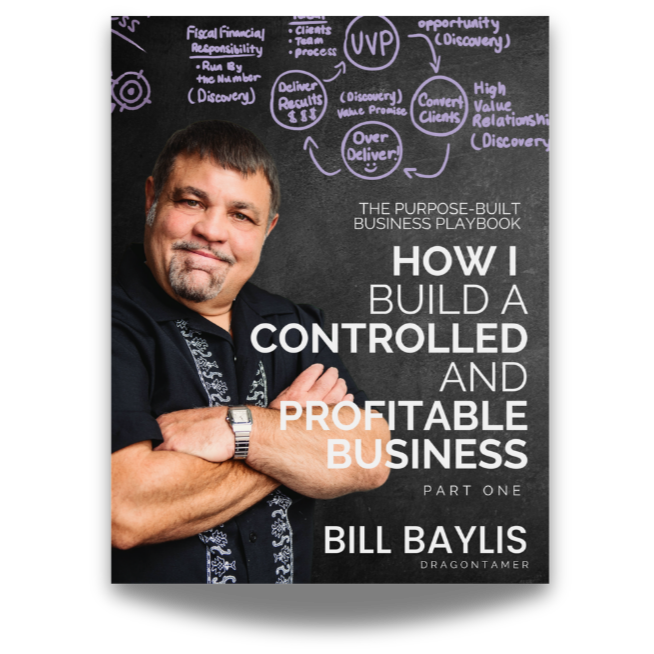
Download The Purpose-Built Playbook today to learn how BDM's diagnostic process uncovers your financial veins of gold and puts you in control of your profitability.